
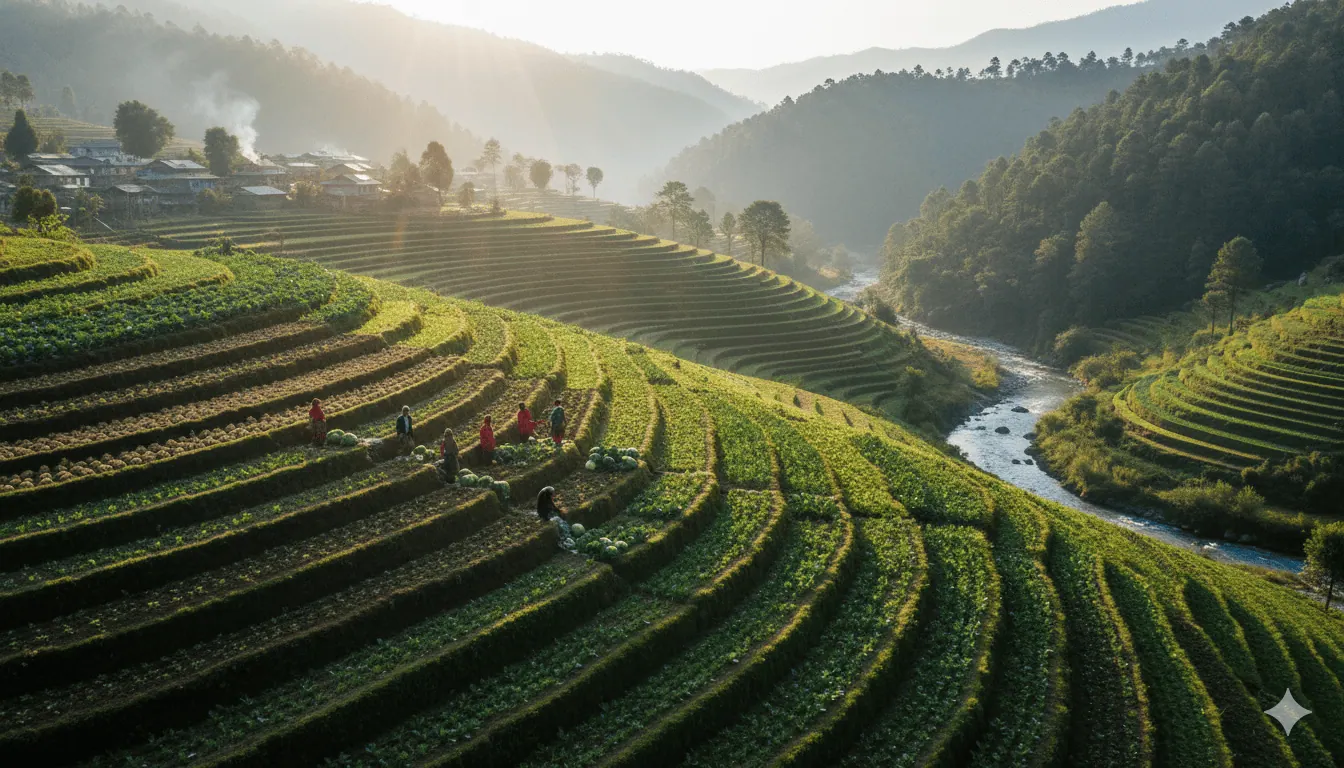
Organic farming in Nepal is more than just a change in agricultural practice — it is a call to rediscover balance, rebuild the bond between people and the earth, and redefine what “development” means. As the global demand for clean, safe, and sustainable food grows, Nepal’s farmers, consumers, and organizations like Vision of Healthy Group are stepping forward to lead the change.
This is the story of how organic agriculture is nourishing Nepal — not only with food but with opportunity, innovation, and hope.
The Need for Change
For decades, chemical fertilizers, pesticides, and hybrid seeds promised abundance. Initially, yields grew, but the long-term cost became clear. Soils lost their fertility, water sources were polluted, and farmers became dependent on expensive imports.
The result? Rising costs, declining health, and a widening gap between the farmer and the consumer. The solution is not to abandon progress but to find a smarter, sustainable path forward — one that honors tradition while embracing innovation.
That path is organic agriculture, a system built on the principles of health, ecology, fairness, and care.
Reviving the Soil — The Foundation of Life
Healthy soil is the foundation of all life. It’s not just dirt; it’s a living ecosystem full of microorganisms, minerals, and organic matter. In many areas of Nepal, overuse of chemicals has weakened this delicate balance.
Vision of Healthy Group’s programs start with soil testing and restoration. Farmers are trained to understand what their soil needs — not just more fertilizer, but proper nutrition and structure.
Through vermicomposting, green manures, and biofertilizers, degraded soils regain their vitality. As a result, crops become more resilient to droughts, pests, and diseases. The land heals — and so does the farmer’s livelihood.
Farmers at the Center of the Movement
The organic revolution puts farmers back in control. Instead of being dependent on middlemen and imported chemicals, farmers learn to produce locally and sell directly.
Vision organizes farmer groups in every ward, providing training, resources, and guaranteed market access. This structure ensures fair prices and stable income. Farmers share knowledge, equipment, and seeds, turning competition into cooperation.
This collective approach also revives the spirit of community — something deeply rooted in Nepali culture. Farming becomes not just a profession but a shared purpose.
Clean Food for Every Family
One of the core missions of Vision is to ensure that every Nepali family can access fresh, clean, and affordable food.
Through its Healthy Kitchen campaign, the organization promotes the philosophy:
“A clean kitchen is our hospital, and food is our medicine.”
The company’s organic cafés and outlets supply safe, chemical-free food sourced directly from partner farmers. Consumers can trace their products back to the soil they were grown in — ensuring trust and transparency.
From fruits and vegetables to dairy, grains, and herbs, each product undergoes strict cleaning, grading, and packaging to maintain hygiene and nutritional quality.
When food is pure, health follows naturally.
Empowering Women and Youth
The movement also recognizes that agriculture is not only about crops — it’s about people. Rural women, often the backbone of farm labor, are now becoming leaders and entrepreneurs.
Through training and microenterprise programs, women are managing organic vegetable gardens, herbal plantations, and processing units. This financial independence empowers families and transforms communities.
Similarly, the youth of Nepal, who once looked abroad for opportunities, are discovering pride and potential in sustainable agriculture. Vision’s education and internship programs offer skill-based training so young people can build their futures at home — not as migrant workers but as innovators and leaders.
The Role of Livestock and Natural Feed
Organic livestock management is a crucial part of sustainable farming. Healthy animals produce healthy food. The company educates farmers about replacing chemical feed with natural, nutrient-rich options like maize, wheat bran, and green forage.
This change ensures better-quality milk and meat and improves animal welfare. When combined with rotational grazing and herbal health care, livestock farming becomes a sustainable, cruelty-free system.
Modern Tools, Traditional Wisdom
The success of organic farming in Nepal depends on the perfect blend of technology and tradition. While ancestral knowledge provides wisdom on crop cycles, herbal pest control, and soil care, modern tools bring precision and scalability.
Vision integrates both worlds — using mobile apps for training and data tracking, while continuing the practice of community-based learning and field demonstrations.
This balance helps farmers stay connected to their roots while becoming part of a global agricultural movement.
Market Access and Fair Trade
The biggest challenge for farmers is often not production but marketing. Many give up when they cannot sell their harvests at fair prices. To solve this, Vision provides market management guarantees.
Farmers sell directly through company outlets or certified partners, avoiding the exploitation of middlemen. Transparent pricing ensures everyone in the chain — from producer to consumer — benefits fairly.
These outlets also create jobs for local youth, who manage distribution, packaging, and digital promotion.
Protecting Nature, One Step at a Time
Organic farming is not only about food; it’s about protecting the earth. By reducing chemical use, the approach safeguards water quality, biodiversity, and air purity.
In cities, waste is turned into compost, creating a circular economy where nothing goes to waste. Recycled organic matter feeds the soil, which in turn feeds the nation.
This eco-friendly loop makes agriculture a tool for climate action — turning farms into carbon sinks and communities into stewards of the environment.
Health and Ayurveda — A Natural Partnership
Nepal’s natural landscape is rich in medicinal herbs, many of which have been used in Ayurveda for centuries. Vision integrates herbal cultivation into its agricultural model, supporting both the health sector and rural economies.
By collaborating with Ayurvedic doctors and local healers, the company promotes natural treatments and herbal wellness products. This fusion of traditional medicine and modern distribution revives an ancient heritage while creating new markets for farmers.
Education and Research — The Seeds of Innovation
No revolution can succeed without education. Vision invests in research and skill-based learning that bridges agriculture, environment, and entrepreneurship.
Farmers learn not just how to grow but why certain practices work. Data collection, scientific observation, and continuous improvement ensure that every season becomes a step toward mastery.
The goal is not to return to the past but to reinvent farming for the future — clean, profitable, and resilient.
Partnerships with Government and Local Bodies
Sustainable change requires cooperation across sectors. Vision works closely with local governments to create policy support for organic farming, promote organic certification, and establish cold storage, transport, and training centers.
These public-private partnerships ensure long-term success, scalability, and national alignment with global sustainability goals.
Helping Vulnerable Communities
The organization dedicates part of its revenue to supporting vulnerable groups — providing food, shelter, education, and healthcare. It runs special programs for differently-abled individuals and orphaned children.
Moreover, it supports rehabilitation and counseling for those recovering from addiction or mental health challenges, offering training and reintegration into meaningful work.
By uplifting those in need, the movement builds not just farms but foundations of hope.
Towards a Circular, Zero-Waste Economy
A sustainable Nepal requires systems that regenerate rather than deplete. Waste composting, renewable energy, eco-friendly packaging, and responsible water use are integral to Vision’s model.
The vision is clear — a circular agricultural economy that reuses, recycles, and restores. Nothing is wasted, and everything contributes to a healthier planet.
The Bigger Dream — A Self-Reliant Nation
Imagine a Nepal where every community grows its own food, purifies its own water, and generates its own income through local enterprise. That’s the future Vision of Healthy Group is building — one partnership, one farm, one family at a time.
Through collaboration across the Himalayas, hills, and Terai, Nepal can become a net exporter of clean, organic produce, boosting GDP and global reputation. Self-reliance is not isolation — it’s independence with integrity.
Conclusion — Growing Together for Generations
Organic agriculture is not a temporary trend; it’s a timeless truth rediscovered. It teaches that prosperity and purity can coexist — that the health of the people is tied to the health of the soil.
Through Vision of Healthy Group’s leadership, Nepal is writing a new chapter of progress — one where farmers are empowered, consumers are informed, and nature is respected.
Every seed planted organically today is a promise to future generations — a promise of nourishment, dignity, and sustainability. The revolution has already begun, and together, Nepal is growing toward a healthier, more harmonious tomorrow.